


“You don’t teach a lesson. You teach children.” –Diane Jackson
This quote is something to be posted high on the walls, scrawled on chalkboards, sent home in letters, and held in the highest regard. Teachers do not teach lessons. Teachers do not teach to empty space, hoping that someone will catch a drift of what they teach. Teachers teach children. Along the same line, teachers are assessing the children that they teach. This assessment cannot be broken into right and wrong, good and bad, x and check. Assessment is a process. What’s more, assessment is not of children, but of their learning. Since this learning belongs to the children, they too must be involved in the process of assessment.
Assessment needs to occur before anything else can be taught. Trying to teach complex astrophysics to an individual with a background in fine arts would not be very fruitful, nor would trying to teach the alphabet song to a linguistics major would. For the fine arts student, the background simply is not there. For the linguistics student, the skill has reached a level of mastery and need not be re-taught. A teacher must find out what students know, what they remember, and what they are capable of. The teacher needs to learn what knowledge and skills 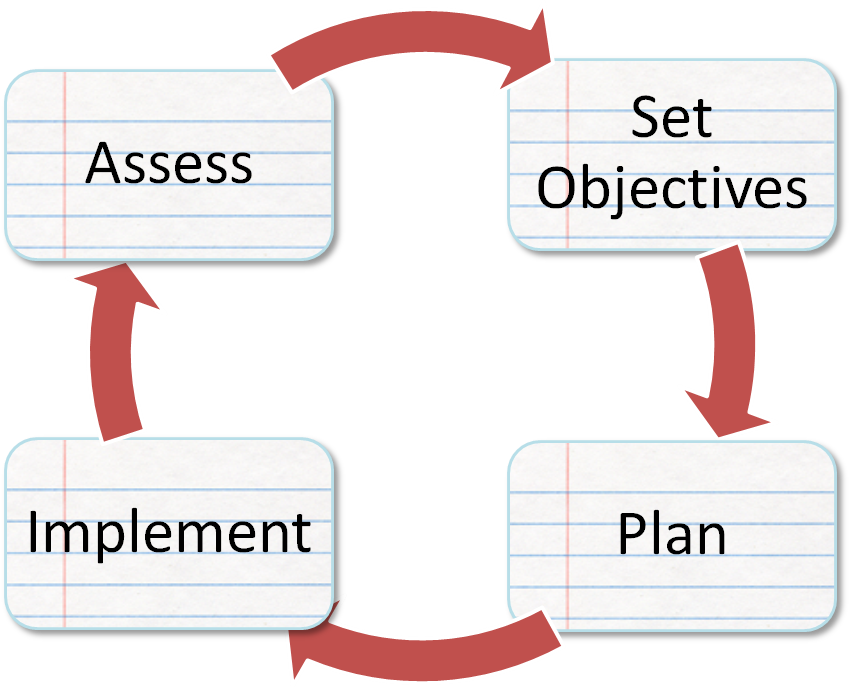 students have mastered, what tools need to be reinforced, and what topics students may have no background knowledge in whatsoever. Without this, it is impossible to set learning objectives for the school year. Thus the teaching cycle illustrated below must start with assessment.
This illustration shows a cycle—it does not begin with assessment and end with implementation. Assessment is ongoing. It must be both formative and summative. Without formative assessment, students do not know what they are doing right. Furthermore, assessment should not simply be the teacher assessing the students work. Students need to become more aware of their own work, of their own successes. Thus self-assessment should also be used as a tool to enhance student learning.
The purpose of assessment should be the same as the purpose of teaching: to help students improve. Not everything should be “worth marks”, in fact, most of what students do in a day should not be worth marks! Assessment and teaching need to be inherently interconnected, and yet they also need to be separated. Teaching needs to come before evaluation. Learning cannot be summatively assessed until it has occurred! Many teachers try to grade everything to have something to enter in their grade book. However the formative assessment is for the students—it is to help them learn, it is to point out where they need more work and to highlight their successes. Thus assessment is ongoing, while evaluation can only come after the teaching, after the children have had a chance to learn.