
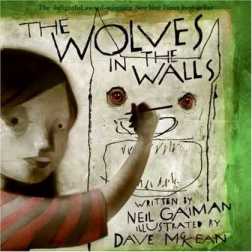
The Wolves in the Walls: The Value of Images |
|||
|
|
||
| Learning Objectives | To appreciate the tone of a story and that it can be changed without changing the words of a story.To appreciate illustrations in picture books.To become more familiar with the elements of writing. | ||
| COMPETENCIES | |||
|
COMPETENCY 3 • TO EXERCISE CRITICAL JUDGMENT
COMPETENCY4 • TO USE CREATIVITY |
||
|
COMPETENCY 1 • TO READ AND LISTEN TO LITERARY, POPULAR AND INFORMATION-BASED TEXTS
COMPETENCY 2 • TO WRITE SELF-EXPRESSIVE, NARRATIVE AND INFORMATION-BASED TEXTS COMPETENCY 3 • TO REPRESENT HER/HIS LITERACY IN DIFFERENT MEDIA COMPETENCY 4 • TO USE LANGUAGE TO COMMUNICATE AND LEARN |
||
|
Language to communicateTalk for learning and thinkingLinguistic structures and features | ||
| Materials | Pencils, papers and ideas. | ||
| References | Gaiman, Neil (2003). The Wolves in the Walls. New York : HarperCollins. 56 pages.This book is an innocent story. The illustrations are dark and unsettling. There is a definite contrast between the words and the images, that when seen together completely change the tone of the story.You can browse inside this book here.
Wikipedia (April 1st, 2010). Plot (narrative). Retrieved April 5th, 2010, fromhttp://en.wikipedia.org/wiki/Plot_(narrative) |
||
| ProfessionalDevelopmentGoals | 2. To communicate clearly in the language of instruction, both orally and in writing, using correct grammar, in various contexts related to teaching.
3. To develop appropriate teaching/learning situations. 4. To pilot teaching/learning situations. 5. To evaluate student progress in learning the subject content and mastering the related competencies. 6. To plan, organize and supervise a class in such a way as to promote students’ learning and social development. 7. To adapt teaching to the needs and characteristics of students with learning disabilities, social maladjustments or handicaps. 12. To demonstrate ethical and responsible professional behavior in the performance of his or her duties. |
||
| OUTLINE | |||
| TIME | ACTIVITY | ||
| Introduction(15-20 min) | Re-establishing concepts of characterization, tone, theme/moral and key plot elements. This material has already been covered—we are simply revisiting and reminding.Interactive class discussion:“What is characterization? How do we learn about characters? How do we relate to characters? What indicates a character’s disposition?”
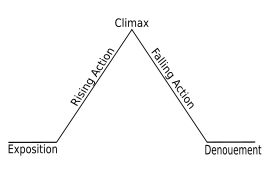
“What is tone? How is it established?” Plot diagram will be drawn on the board:
(Wikipedia, 2010) Students should actively participate and share their concepts of the terms. They will be invited to write down elements of the discussion. The teacher will record important issues on the board (SMARTboard, blackboard, whiteboard…it doesn’t matter!) |
||
| Focus(1h 15min) | Reading of The Wolves in the Walls. It is a 56 page picture book.ONLY the text will be read. The pictures will be hidden from the students.Students will write down their perceptions of the story based on the questions below. This is individual, reflective work and should be done in relative silence.
On the board the teacher will outline the assignment: Write the key plot elements based on our plot diagram. Describe the main character in one or two sentences. Describe one other character in one or two sentences. What is the tone of the story? How can you tell? Write two or three sentences. What do you think the theme or moral to the story is, based on what you know about fairy tales and what you have heard in this story? Write as much as necessary. If some students finish before others, they may draw how they think their favourite character would look, or they may draw their favourite scene from the book. All students should have at least 10 minutes to do this—the activity can be extended should they require more time. Once everyone has completed the activity, students will be invited to share and discuss their thoughts and opinions. This will be student guided discussion. |
||
| Closing (45 min) | 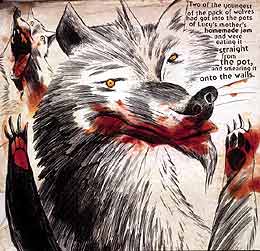
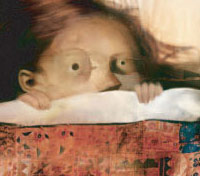
After this discussion, the teacher will read the story once again, this time showing the illustrations. Students will once again discuss their new ideas about the characters and the tone of the story, and how the images have altered their ideas. They will discuss the impact of the images and how they now feel about the story. This discussion will be mostly student guided, however the teacher will also raise the questions above. The discussion can go in any direction, and the teacher will not guide the answers, only ask the questions. Students will write one paragraph about their thoughts on the activity and the discussion on the same sheet as the first activity. The assignment and the drawings will be collected. |
||
Pages
- 1. Rationale of Unit Plan: Imagine a School…
- 2. Topic: What is Fear?
- 3. Materials
- 4. Lesson Plans
- Lesson 01: The Wolves in the Walls–The Value of Images
- Lesson 02: Word Wall of Terror
- Lesson 03: Three Innocent Piglets Devoured by the Savage, Ferocious Wolf–Horrorifying Fables
- Lesson 04: Look Fear in the Eye–Creating Horrific Art and Illustrations
- Lesson 05: Parts 1 and 2–A Song is Worth 1000 Screams
- Lesson 06: What Makes a Villain?
- Lesson 07: Disney's Villains–What Makes Evil?
- Lesson 08: Grimm vs. Disney
- Lesson 09: The Media Scares Me…
- 5. Assessment
- 6. Reflection
- About